What this book does
Rested begins by separating two states that most people call “tired”. Sleepiness is how easily sleep would take you if you let it. Fatigue is low energy or a lack of drive, and it can be there when you would not fall asleep if you tried. In a study of 283 patients at a sleep clinic, scores for the two barely moved together. When they come apart, an earlier night helps one and may barely touch the other. The introduction, which is in the free sample, ends with a two-question check you can run for a week to see which one you are dealing with.
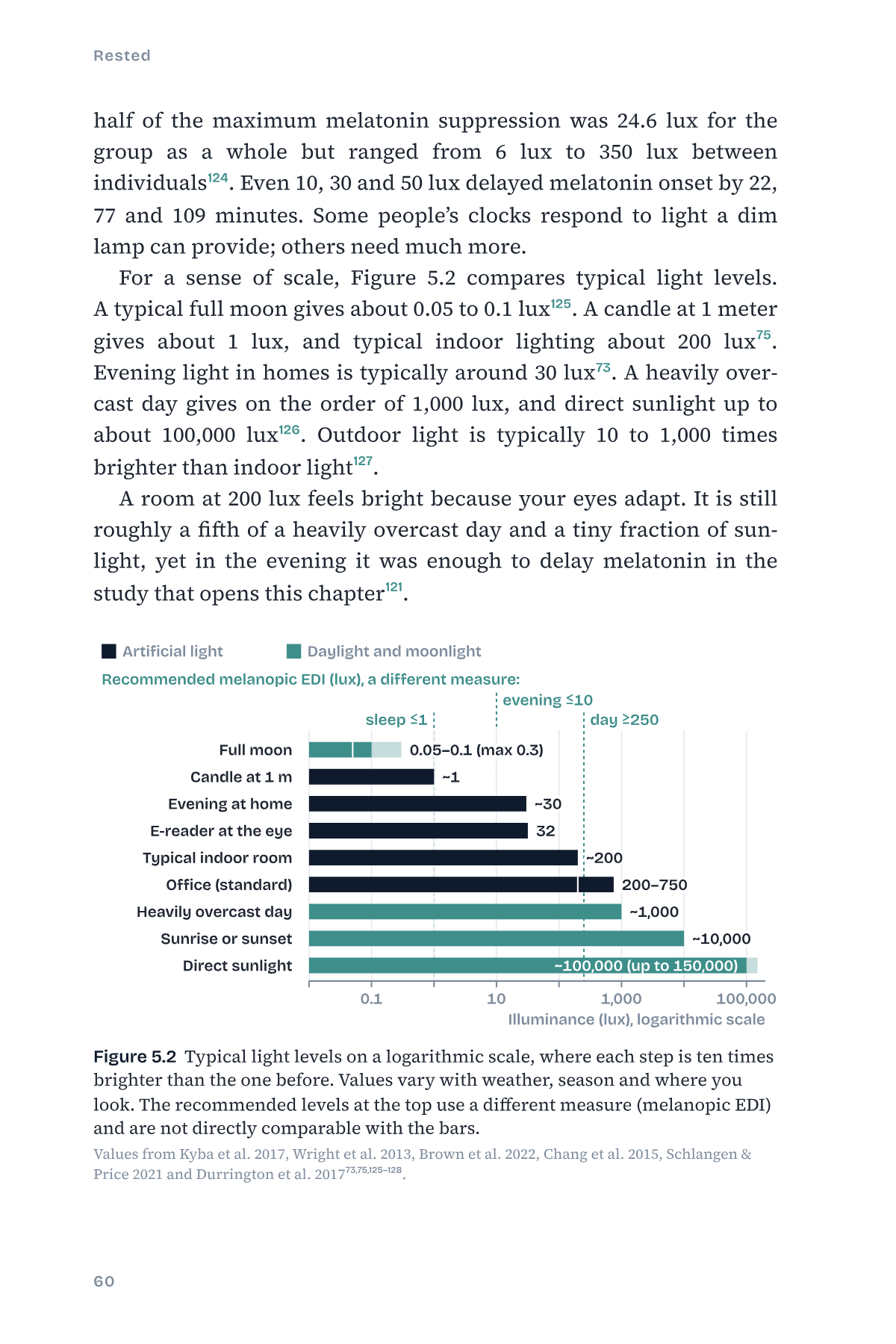
From there the book explains how sleep works and goes through what you can change, and every number comes with who was measured. Caffeine is one example. Adults take 3 to 7 hours to clear half a dose, and a meta-analysis of 24 studies estimated that a typical coffee should be drunk at least 8.8 hours before bed: for a 23:00 bedtime, around 14:00. That is a model estimate for an average person, and the book says so. Light, alcohol, exercise, naps, shift work and insomnia get the same close reading.
Every recommendation carries an evidence grade of strong, moderate or limited, and some popular advice grades poorly. A Cochrane review could not say whether blue-light-filtering glasses improve sleep. In a trial of 167 iPhone users aged 18 to 24, the Night Shift setting made no measurable difference to sleep. Factual statements are tied to 220 numbered sources.
The book is written for tired working adults who want to understand what is going on before they change anything, including people who have tried the usual tips and doubt them. It ends with the four-week plan described below. It is general information, not medical advice, and boxes headed “See a doctor if…” mark the signs that call for a doctor first.
What’s inside
An introduction, eleven chapters, a glossary and a note on sources and method. Each chapter ends with a section on what to do with it and a short list of key points.
Tired is not one thing
Sleepiness and fatigue feel alike from the inside, but they can have different causes and often respond to different fixes.
- 1
What happens when you sleep
A night of sleep has a predictable shape, and knowing it makes many common worries about sleep smaller.
- 2
Two clocks: sleep pressure and the circadian rhythm
How sleepy you feel at any hour depends on two separate systems, one that tracks time awake and one that tracks time of day.
- 3
How much sleep you need
The expert answer for adults is at least 7 hours, but your own number can sit an hour or more away from the average.
- 4
What short sleep costs
A few short nights do measurable damage to attention, mood and appetite, and the strangest finding is how little of it you feel.
- 5
Light, the strongest lever you control
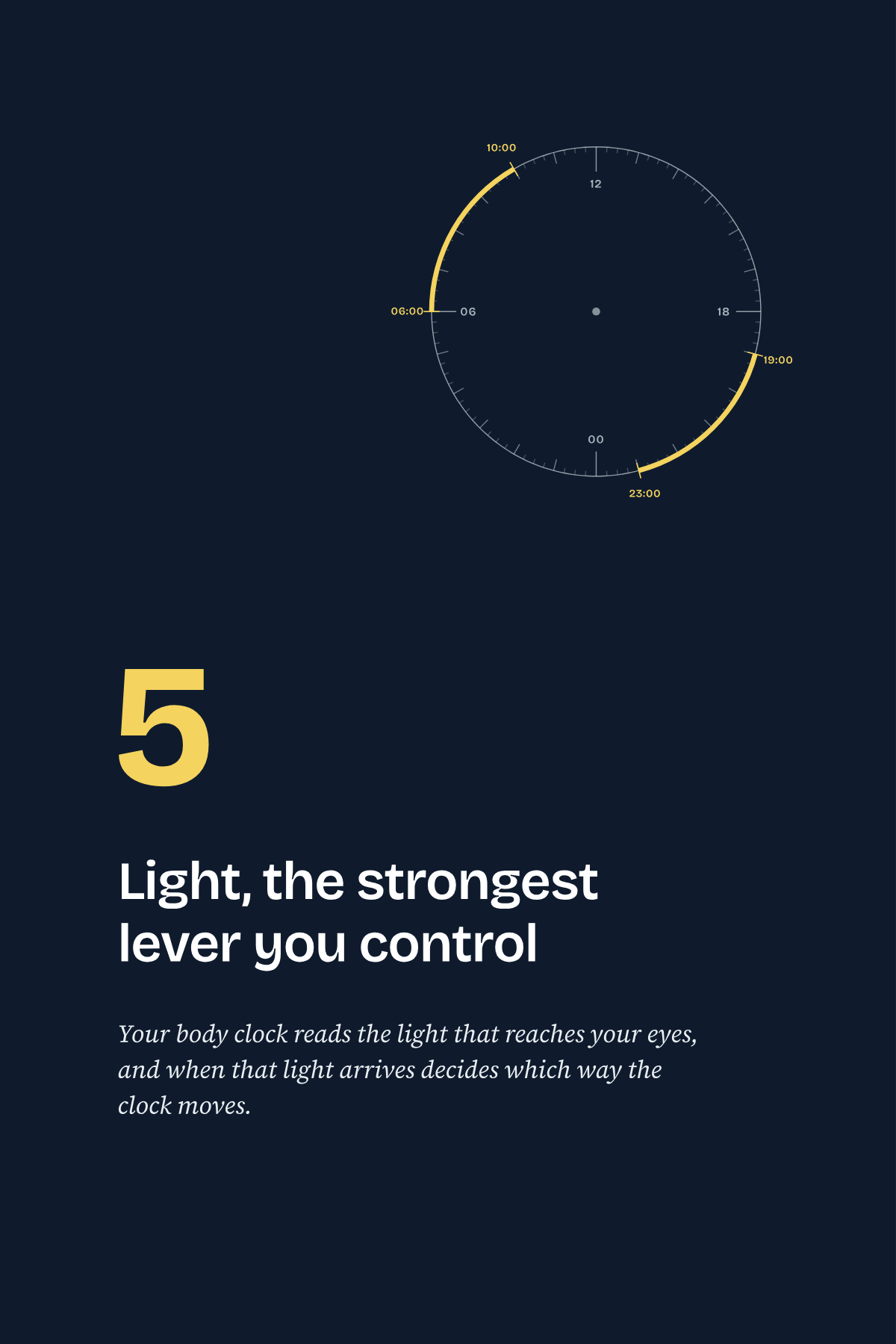
Your body clock reads the light that reaches your eyes, and when that light arrives decides which way the clock moves.
- 6
Caffeine, alcohol and what else you swallow
Caffeine lingers longer than it feels, and alcohol buys the first hours of the night at the expense of the rest.
- 7
Exercise, temperature, food and timing
Movement, a warm bath and a bedroom that isn't hot each help sleep a little, and an earlier dinner helps mainly if you get heartburn.
- 8
When you can't sleep: insomnia and CBT-I
The best-supported treatment for chronic insomnia asks you to spend less time in bed, and at first it makes you sleepier.
- 9
Naps, shifts, jet lag and irregular lives
When sleep can't happen at the usual time, length and timing decide most of what you get back.
- 10
Daytime energy without fighting your biology
Alertness rises and falls on a schedule of its own, the useful moves work with that schedule, and some tiredness is a medical signal.
- 11
Your four-week plan
One group of changes per week, a diary to show what each one did, and a clear line for when to stop experimenting and see a doctor.
How the evidence is graded
Each time the book recommends something, a box headed “Evidence” gives a verdict and a grade, shown as three dots. The grade describes the evidence behind that particular piece of advice, not the topic as a whole. When the biology is solid but the advice built on it has not been tested in everyday life, the advice gets the lower grade, and the box says why.
Strong does not mean large. Cognitive behavioral therapy for insomnia (CBT-I) is the first-line treatment for chronic insomnia in American and European guidelines, yet in a meta-analysis of 20 trials it shortened the time to fall asleep by about 19 minutes and barely changed total sleep time.
- Strong
Consistent results from several good randomized trials or meta-analyses, or a consensus at the level of clinical guidelines.
- Moderate
Support from at least one good meta-analysis or several consistent studies, with real limits: small samples, short follow-up, mixed results, or mostly lab conditions.
- Limited
Few or small studies, observational data only, animal work, or a reasonable inference from mechanisms that has not been tested directly. Where the answer is “we don’t know”, the book says so.
Look inside
The four-week plan
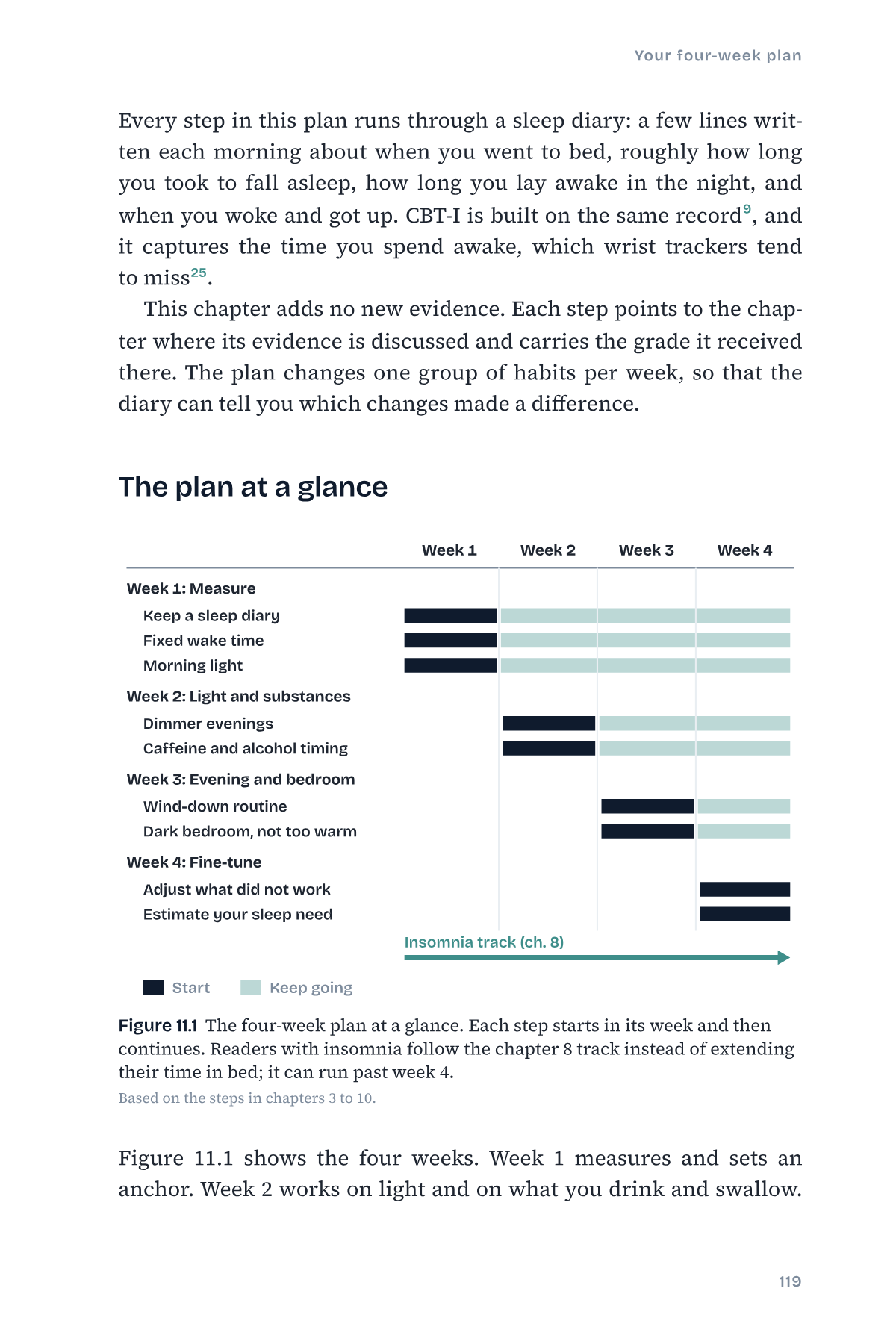
Chapter 11 turns the book into a plan: one group of changes per week, a sleep diary to show what each one did, and a clear line for when to stop experimenting and see a doctor. Each step carries the grade it received in its chapter. Readers with chronic insomnia follow a separate track from chapter 8, which starts in week 1 and comes with its own safety rules.
Week 1: measure and anchor
Keep a sleep diary each morning, get up at the same time every day, and get outdoor light early. Change nothing else, so the diary has a baseline.
Week 2: light and what you swallow
Brighter days, dim and warm light for the last 3 hours before bed, caffeine moved earlier, and no alcohol as a sleep aid.
Week 3: evenings and the bedroom
A wind-down routine, a hot bath or shower 1 to 2 hours before bed if you like, a dark bedroom that isn’t hot, and regular exercise.
Week 4: fine-tune and estimate your need
Compare the diary with week 1, keep what moved your numbers, plan for the afternoon dip, and make a first estimate of how much sleep you need.
Details
- Pages
- 151
- References
- 220
- Figures
- 14
- Format
- Languages
- English. German and Spanish editions are sold separately.
- Delivery
- Download page right after payment
Questions
How do I get the PDF?
Right after payment, the checkout takes you to a download page for your edition. Download the PDF there and bookmark the page, because it is your copy of the download link. Link (Stripe) sends the receipt and invoice by e-mail, and they do not contain the download link.
If you lose the page, or the payment went through but you never reached it, write to the e-mail address on the Imprint page from the address you used at checkout, and the link will be sent to you again.
Can I read it on a phone, tablet or e-reader?
Yes, on any device that opens PDF files. The page size is 6 × 9 inches, so the book reads most comfortably on a tablet, a computer or a large e-reader. On a phone you will need to zoom.
Can I get a refund or cancel the purchase?
The sale is made by Link (Sold through Link, LLC) as merchant of record, under Link’s purchase terms (link.com/en-sk/terms). If you are a consumer in the EU or the UK, those terms give you a right to cancel within 14 days from the date you receive access to the book.
Refund requests go to Link’s support. Link’s refund policy (support.link.com/questions/sold-through-link-refunds) also covers a file that never arrived, is damaged or corrupted, or is significantly not as described.
Is this medical advice?
No. Rested is general information about sleep, written for adults. It cannot diagnose you, it gives no doses for any medicine or supplement, and it cannot replace a doctor who knows you.
See a doctor before you try the plan if you snore loudly and are sleepy by day, if someone has heard you gasp, snort or choke in your sleep, or if you have felt tired for more than a few weeks without a clear reason. If you have a diagnosed sleep disorder, are pregnant, work in a safety-critical job, or take medicines that affect sleep or alertness, talk to your doctor before changing how you sleep. The book’s boxes headed “See a doctor if…” give the full list of warning signs.
I have slept badly for months. Is this the right place to start?
Chapter 8 describes chronic insomnia: trouble falling asleep, staying asleep or waking too early, despite enough time in bed, with effects during the day, at least three nights a week for at least three months. If that fits you, the book’s advice is to look for cognitive behavioral therapy for insomnia (CBT-I), with a trained clinician or a structured digital program. American and European guidelines name it as the first-line treatment.
The book does not replace that treatment. Chapter 8 explains its parts, what the trials found and the safety rules. One part, sleep restriction, makes people sleepier at first, and the chapter lists who should use it only with a clinician.
Do I need a sleep tracker or any other device?
No. The plan runs on a sleep diary written each morning, and chapter 11 includes a template. In a lab comparison of seven consumer devices tested on 34 healthy young adults, the devices correctly identified at least 93% of the time people were asleep but only 18 to 54% of the time they were awake. If you use one, the book suggests reading it for trends in timing and duration only.
Which languages is it available in?
English, German and Spanish. The German edition is called Ausgeschlafen and the Spanish edition Descansado. Each edition is a separate PDF with its own page in its language.
Can I read a sample first?
Yes. The free sample contains “How to read this book”, the introduction and chapter 1, together with the full table of contents. It downloads directly from this page, with no e-mail address needed.
Who wrote it?
Rested is written by Miroslav Špaček. The note at the end, “About this book”, describes the method: four research passes gathered the evidence before any chapter was drafted, and a separate reviewer then compared every cited sentence with the research notes and checked a sample of the sources against the original publications.